
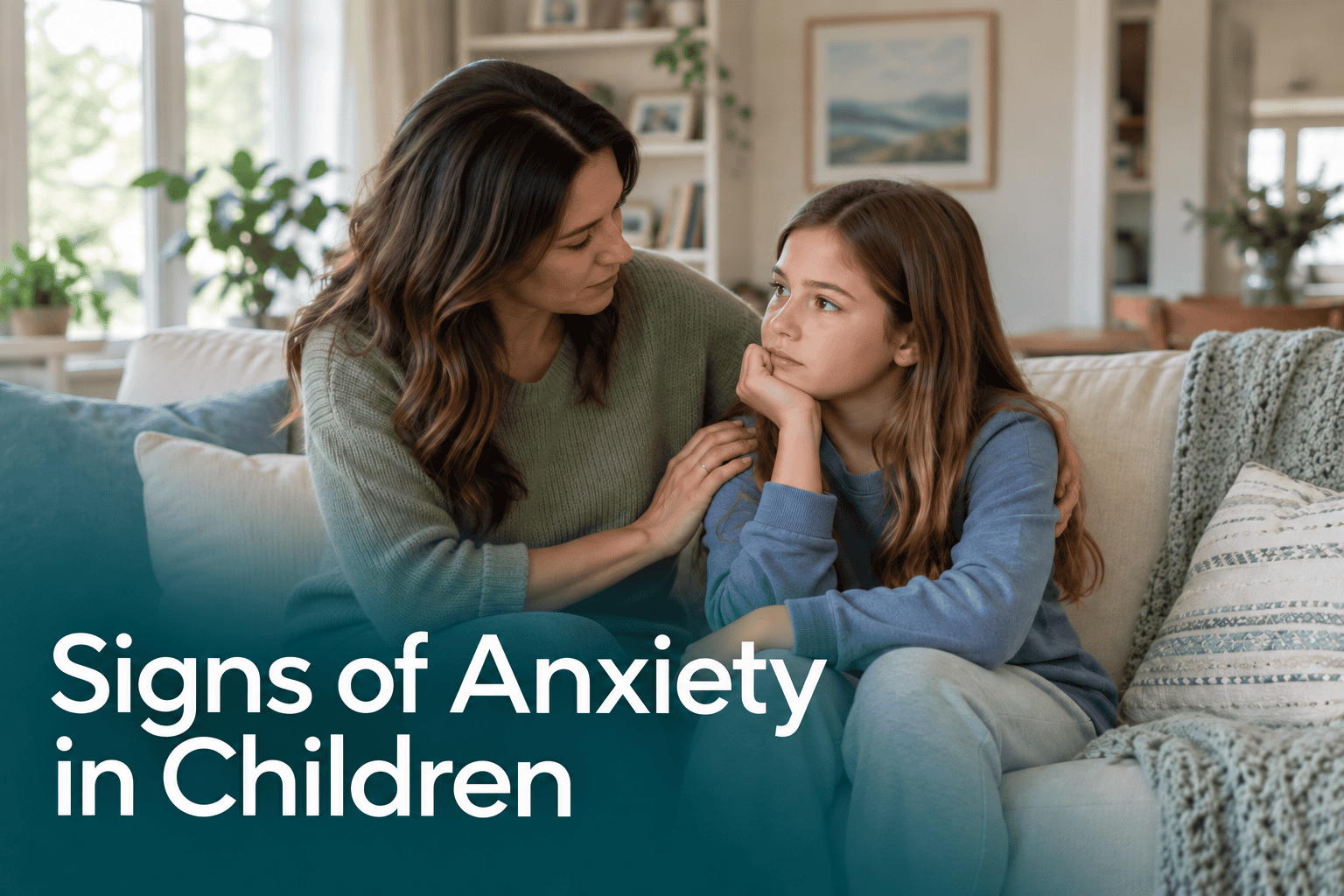
Signs of Anxiety in Children
Your child says their stomach hurts every morning before school. Your teenager spends hours worrying about an assignment that looks finished to you. Bedtime brings repeated questions about tomorrow, and a simple change in plans can turn into tears.
As a parent, you may wonder whether you are seeing everyday childhood worries or something that needs professional attention. You may also feel unsure about how to respond. Should you encourage your child to push through, give them more reassurance, or ask for help?
Recognizing anxiety in children and adolescents begins with looking beyond any single difficult moment. What matters is the pattern: how often worry appears, how distressing it becomes, and what it prevents your child from doing.
This guide can help you organize your observations, understand treatment options, and decide when to contact Northland Child Psychiatry.
When Is Childhood Worry More Than a Passing Phase?
Children naturally experience fears as they grow. A young child may hesitate around unfamiliar people. A school-age child may worry about a test. A teenager may feel nervous before meeting a new group of friends.
An occasional worry does not establish an anxiety disorder. Clinicians consider a child’s developmental stage, the circumstances, and the extent of distress or interference.
For parents, three questions can help:
- How strong is the reaction? Does the fear seem overwhelming or difficult to recover from?
- How persistent is the pattern? Does the same concern return repeatedly?
- What is the impact? Is worry disrupting school, sleep, relationships, or ordinary activities?
For example, feeling nervous before a birthday party is different from repeatedly missing parties your child wants to attend because fear makes going feel impossible.
The National Institute of Mental Health recommends seeking help when symptoms last weeks or months and interfere with everyday functioning. Significant distress warrants attention sooner; you do not need to wait for a particular deadline before asking for guidance.
Signs of Anxiety in Children That Parents May Notice
Children may describe anxiety through feelings, physical discomfort, or behavior. Some can explain what frightens them. Others simply say, “I don’t know,” when you ask what is wrong.
The following examples illustrate possible patterns. They are not a diagnostic checklist.
Worries That Keep Returning
Your child may frequently ask:
“What if something happens to you?”
“What if I make a mistake?”
“What if nobody wants to sit with me?”
You answer thoughtfully, but the relief seems brief. Soon, the same question returns.
Repeated reassurance seeking can accompany anxiety, especially when a child struggles with uncertainty. The American Academy of Child and Adolescent Psychiatry also notes that anxious children may be quiet, cooperative, and eager to please. Their distress can be easy to miss.
Avoiding Separation or Social Situations
A child may resist staying with a familiar caregiver, become distressed at school drop-off, or repeatedly check that a parent is nearby.
Another child may want friends but avoid joining conversations, attending gatherings, or speaking in front of others.
For instance, your child might spend the week looking forward to a sleepover, then become increasingly upset as departure approaches. That change is worth discussing with curiosity: “What started feeling difficult about going?”
Look at what happens across situations rather than assuming one canceled plan means anxiety.
Recurring Physical Complaints
Anxiety can involve stomachaches, headaches, fatigue, and difficulty sleeping. Children may also seem irritable or angry rather than visibly frightened. The CDC’s guidance on childhood anxiety describes these less obvious symptoms.
Take physical discomfort seriously. Recurring pain should be discussed with your child’s pediatrician rather than automatically attributed to anxiety.
A useful observation might be: “The stomachache happened before school three mornings this week.” That gives a clinician more information than deciding in advance that your child is either sick or avoiding school.
Perfectionism and Fear of Disappointing Others
A child may erase an answer repeatedly, restart a project, or become deeply upset about a minor mistake. A teenager may earn strong grades while feeling unable to relax about schoolwork.
The question is not simply whether your child works hard. Consider how much distress surrounds the work and whether they can tolerate ordinary mistakes.
NIMH explains that children and teens with generalized anxiety may worry about school, friendships, uncertainty, and disappointing others. Concentration and sleep can also become difficult.
Changes at School
Anxiety may show up as repeated requests to visit the nurse, difficulty participating, frequent questions about instructions, or trouble completing work. These behaviors can have several explanations.
The Child Mind Institute’s discussion of anxiety at school emphasizes that anxiety can be mistaken for other difficulties.
Ask teachers for specific observations: When does your child struggle? What happens before they ask to leave? Are certain classes or activities harder? Information from school can reveal patterns that are not visible at home.
Different Forms of Anxiety Can Look Different
Anxiety is a category of conditions rather than one identical experience.
Separation anxiety involves excessive fear about being apart from attachment figures, beyond what is expected for the child’s developmental stage.
Social anxiety involves fear of scrutiny, embarrassment, or negative judgment in social situations.
Generalized anxiety involves excessive, hard-to-control worry across areas of everyday life.
Specific phobias involve intense fear related to a particular object or situation.
These distinctions help guide treatment, but parents do not need to identify the correct diagnosis before reaching out. The CDC provides an overview of childhood anxiety conditions.
When describing your concerns, plain language is enough. “She worries something will happen to me while she is at school” is more useful than trying to choose a medical term. So is, “He wants to participate but becomes overwhelmed when people might watch him.”
Your role is to share what you notice. The clinician’s role is to help interpret it.
Could the Symptoms Have Another Explanation?
Difficulty concentrating, irritability, and withdrawal do not point to one diagnosis on their own. An evaluation may consider medical concerns, developmental differences, school difficulties, stressful experiences, and other mental health conditions.
Anxiety and depression can also occur together. Mention persistent sadness, loss of interest, or major changes in motivation rather than assuming every change comes from worry.
Northland Child Psychiatry evaluates a range of child and adolescent mental health conditions. That broader perspective matters when a child’s symptoms do not fit a simple explanation.
Consider two children who both avoid homework. One might fear getting an answer wrong; another might struggle to understand the material. A third possibility is that both issues are present.
Parents should not have to sort out those possibilities alone. As NIMH explains in its guide to children’s mental health, an assessment helps clarify a child’s emotions, behavior, and circumstances so recommendations address their actual needs.
How to Support a Child Who Feels Anxious
You do not need a perfect response every time your child worries. Start with a few consistent approaches, and ask a clinician for guidance when the pattern becomes difficult to manage.
Begin With Curiosity and Connection
Choose a relatively calm moment to talk. A conversation during a rushed school departure may be harder than one during a walk or quiet activity.
Try an observation followed by an open question:
“I noticed you got quiet when we talked about tomorrow. What are you thinking about?”
Allow time for an answer. If your child cannot explain, avoid turning the conversation into an interrogation. You can return to it later.
The American Academy of Pediatrics recommends regular connection and learning what is worrying your child, including possible stressors such as bullying or changes at home.
Acknowledge Feelings and Express Confidence
A helpful response can recognize distress while communicating that support is available:
“I can see this feels hard. We can work out the next step together.”
You do not have to promise that nothing uncomfortable will happen. Instead, focus on helping your child feel capable of responding.
The Child Mind Institute recommends respecting feelings, setting realistic expectations, and helping children build the ability to cope with anxiety.
Approach Avoidance Thoughtfully
Canceling a feared activity may bring immediate relief, but repeated avoidance can help maintain anxiety. At the same time, overwhelming a child is not a useful treatment plan.
For significant fears, seek guidance on gradual, manageable practice. An agreed first step might be much smaller than completing the entire activity.
Actual safety concerns, including bullying, need to be addressed directly. The aim is to help a child approach safe situations with support, not to dismiss a legitimate problem.
Support Predictable Daily Routines
Regular meals, sleep routines, movement, and time together can support emotional well-being. Practice simple coping strategies when your child is calm so they are familiar before a difficult moment.
You might practice slow breathing together or rehearse asking a teacher for help. Praise the effort involved: “You felt nervous and still tried the first step.”
These approaches are consistent with the AAP’s advice for supporting anxious children. They support care but do not replace an evaluation when anxiety is interfering with daily life.
When Should You Seek Professional Help?
Reach out when worry repeatedly limits your child’s activities, distress is increasing, or your family is struggling to manage the situation.
Examples worth bringing to a clinician include:
- Recurring difficulty attending or staying at school.
- Fear that prevents age-appropriate independence.
- Sleep disruption affecting daytime functioning.
- Withdrawal from friends or activities.
- Distress that continues despite your efforts to help.
You can start with your child’s pediatrician or a qualified mental health professional. AACAP recommends an evaluation when anxiety becomes severe and interferes with usual activities.
If you are unsure whether an appointment is appropriate, contact Northland Child Psychiatry to ask about the evaluation process. You do not need to arrive with a diagnosis or a complete explanation.
What Happens During an Anxiety Evaluation?
An evaluation is an opportunity to understand the child behind the symptoms.
At Northland Child Psychiatry, the initial appointment lasts approximately 75 minutes. Dr. Brayden Willis reviews intake information and speaks with the patient and parent or guardian.
The assessment considers current concerns, medical and developmental history, other psychiatric symptoms, school, relationships, and home life. Learn more about the practice’s comprehensive psychiatric evaluation and services.
Parents sometimes worry that they will forget something important or explain things incorrectly. Concrete examples are helpful, and it is acceptable to say, “I’m not sure.”
Your child may describe the situation differently from you. Both perspectives can be useful. For example, you may see a long homework struggle while your child describes fear about being called on the next day.
The appointment provides space to discuss those differences and ask what they might mean.
How Is Anxiety in Children Treated?
Treatment is tailored to the child’s age, diagnosis, symptoms, and daily functioning. It may include therapy, parent involvement, school support, medication, or a combination.
Cognitive Behavioral Therapy
Cognitive behavioral therapy, or CBT, is an established treatment for childhood anxiety. It helps children recognize anxious thinking and practice different responses to feared situations.
Treatment often includes gradual exposure: approaching safe but anxiety-provoking situations in planned steps. A child works toward doing more even when some nervousness remains. NIMH describes evidence supporting CBT for children with anxiety disorders.
Parents can ask what skills their child will practice, how they can support practice at home, and how progress will be assessed.
Medication When Appropriate
Medication may be considered when symptoms and treatment needs warrant it. Selective serotonin reuptake inhibitors, or SSRIs, are among the medications used for pediatric anxiety.
A prescribing clinician should discuss expected benefits, potential side effects, and monitoring. Antidepressants carry a warning about increased risk of suicidal thoughts and behaviors in children and young people, making follow-up important, particularly early in treatment or after dose changes.
Families can review AACAP’s Anxiety Disorders: Parents’ Medication Guide when preparing questions. Medication decisions should be individualized rather than based on another child’s experience.
Follow-Up and Treatment Goals
Useful goals connect care to everyday life. Your family might hope for easier school attendance, less distress at bedtime, or greater participation with friends.
Ask the clinician what improvement could look like and when to review the plan. Share ongoing difficulties as well as successes. A treatment plan can be reconsidered as the child’s needs change.
How to Prepare for Your Child’s First Appointment
A few notes can make the visit easier. Record when the concerns began, where they occur, and how they affect daily routines. Include previous evaluations, current medications, and relevant school observations.
Keep examples brief and factual:
“On three mornings this week, getting into the car took about 30 minutes because he was crying about school.”
That is more informative than “Mornings are always terrible.”
Ask your child what they would like help with, too. Their priority may differ from yours.
You might bring these questions:
- What could explain the symptoms?
- What treatment options fit my child’s needs?
- How should we respond during difficult moments?
- What should we discuss with the school?
- When should we contact you between appointments?
You can learn about Dr. Willis before the visit and explain that the appointment is a chance to understand what has been hard.
Questions Parents Often Ask About Childhood Anxiety
Can a Child Have Anxiety and Still Earn Good Grades?
Yes. Academic performance is only one part of the picture. Consider how your child feels, how much effort daily tasks require, and whether worry affects other parts of life.
Mention distress even when report cards look strong. Perfectionism and fear of mistakes can be relevant concerns.
Should I Wait for My Child to Ask for Help?
You can raise concerns yourself. Some children cannot identify their feelings clearly, and others find discussing them difficult.
Begin with observations rather than labels. “I’ve noticed bedtime has become stressful” may open a conversation more easily than asking your child to decide whether they have anxiety.
Does Seeing a Psychiatrist Mean Medication Is Required?
No. An evaluation helps determine appropriate recommendations. Northland Child Psychiatry’s approach to medication management includes considering risks and benefits and discussing decisions with families. Some patients may not need medication.
Can Follow-Up Appointments Be Virtual?
Northland Child Psychiatry offers secure video follow-up visits for many established patients when clinically appropriate. Some circumstances require an in-person appointment.
Ask the office which arrangements are appropriate for your child when discussing ongoing care.
What If I Am Worried About Immediate Safety?
If your child is struggling with suicidal thoughts or a mental health crisis, call or text 988 for immediate support. For immediate danger or a life-threatening emergency, call 911. Do not wait for a routine appointment.
Find Help for Childhood Anxiety in Missouri and Kansas
Recognizing a pattern of worry can leave parents with more questions than answers. You may know your child is struggling without knowing why, or feel uncertain about which kind of help to seek.
You can begin with what you know: the mornings that have become harder, the activities your child misses, or the worries that keep returning. Those observations are enough to start a conversation.
Northland Child Psychiatry provides psychiatric care for children and adolescents up to age 18 throughout Missouri and Kansas, with an office in Liberty, Missouri.
If anxiety is affecting your child or your family’s daily life, request an appointment with Northland Child Psychiatry or call 816-819-5166.
An evaluation can help your family understand what is happening and develop a plan for the next step.