ADHD or Anxiety? How Focus Problems Can Look Similar in Children and Teens
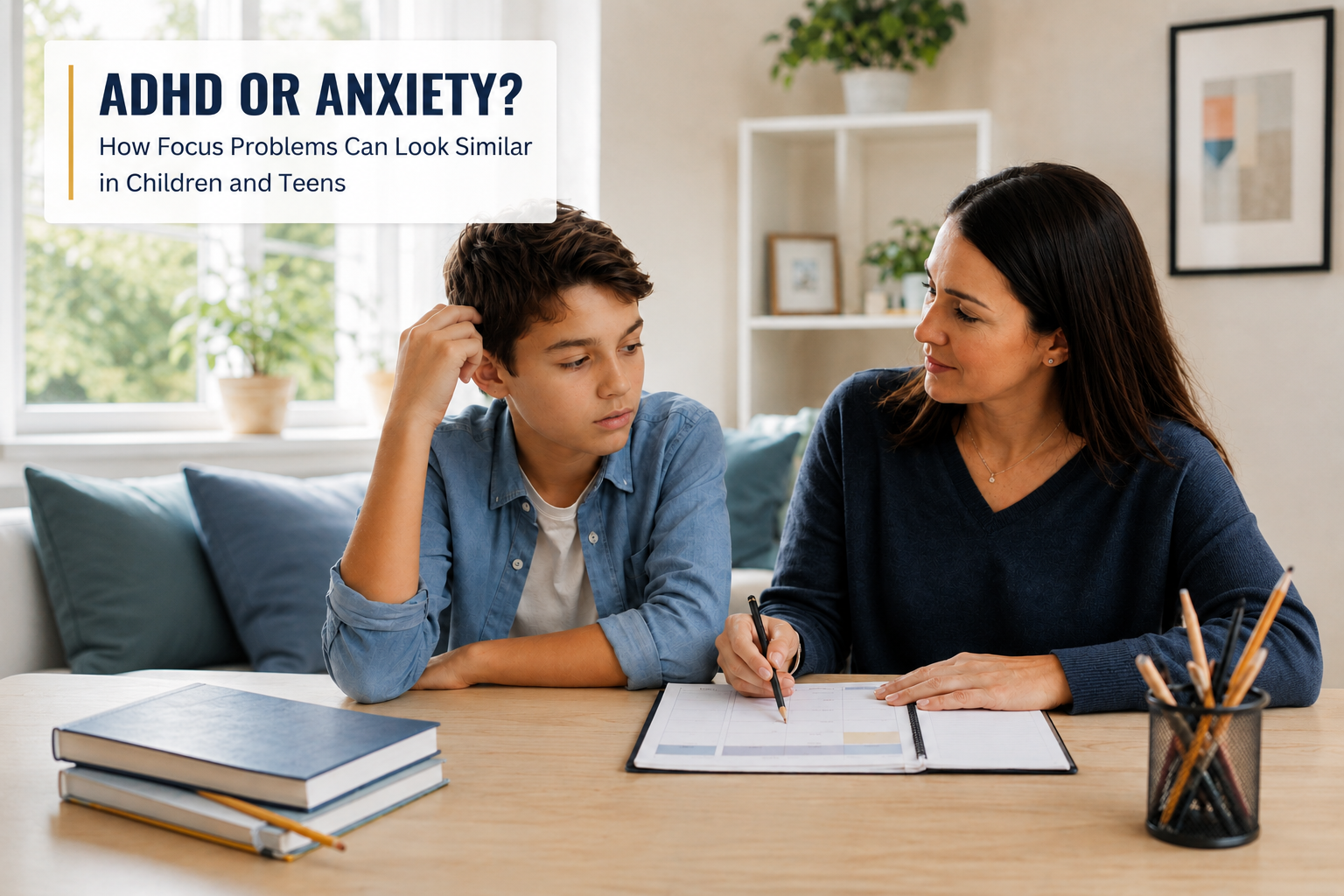
A child stares at a homework page but cannot get started. A teenager rereads the same paragraph several times without remembering it. A teacher reports unfinished work, while the child insists they were trying.
Parents often wonder whether these patterns point to attention-deficit/hyperactivity disorder, anxiety, a temporary response to stress, or something else entirely. The question is understandable because ADHD and anxiety can both affect concentration, organization, task completion, sleep, classroom participation, and relationships.
However, similar outward behavior does not necessarily have the same cause. A child who loses focus because their attention shifts quickly may need something different from a child whose attention is consumed by fear of making a mistake. Some children also experience both ADHD and anxiety.
This article cannot determine what is happening for an individual child. It can help parents understand the patterns a clinician may explore during a careful evaluation.
Why ADHD and anxiety can look similar
Focus is not a single skill that works independently from the rest of a child’s life. Attention can be influenced by interest, worry, sleep, physical health, developmental stage, learning demands, relationships, sensory experiences, stress, and the environment.
The Centers for Disease Control and Prevention explains that several conditions can produce symptoms resembling ADHD. It also notes that anxiety can occur alongside ADHD. This is one reason a symptom checklist alone cannot establish a diagnosis.
A distracted child may be:
- Having difficulty regulating and directing attention
- Thinking repeatedly about something that could go wrong
- Avoiding a task because it feels overwhelming
- Struggling with sleep, stress, or a physical-health concern
- Missing instructions because the material is difficult to process
- Dealing with more than one concern at the same time
Instead of asking only, “Is my child distracted?” it is more helpful to ask when the distraction happens, what appears to trigger it, what the child is thinking or feeling, and how consistently it affects daily functioning.
How ADHD may affect attention and organization
ADHD is a neurodevelopmental condition involving ongoing patterns of inattention, hyperactivity, impulsivity, or a combination of these features. The National Institute of Mental Health describes ADHD as involving difficulties with attention, staying on task, organization, activity level, or impulse control.
For a diagnosis to be considered, clinicians look for more than an occasional problem with focus. They explore whether the pattern is persistent, developmentally significant, present in more than one part of the child’s life, and interfering with functioning.
ADHD-related difficulties may include:
- Losing track of multi-step directions
- Starting a task but becoming pulled toward another activity
- Forgetting assignments, materials, or routine responsibilities
- Underestimating how long a task will take
- Making quick mistakes even when the child understands the material
- Interrupting, acting before thinking, or struggling to wait
- Needing frequent reminders to return to a task
These patterns can vary with structure, novelty, interest, fatigue, and the amount of immediate feedback available. A child’s ability to remain absorbed in a favorite activity does not automatically rule ADHD in or out.
Parents who want a broader introduction can read Northland Child Psychiatry’s article about ADHD symptoms and coping strategies in children.
How anxiety may disrupt concentration
Anxiety can occupy the mental space a child needs for learning, remembering instructions, and completing work. The child may appear distracted, but their attention may actually be locked onto worry.
For example, a student may miss part of a lesson because they are thinking about being called on. A teenager may delay an assignment because they are afraid the result will not be good enough. A child may repeatedly check their work, erase correct answers, or ask for reassurance rather than moving to the next step.
The American Academy of Child and Adolescent Psychiatry notes that some childhood fears are developmentally expected. Anxiety becomes more concerning when worries are severe, persist over time, or interfere with activities such as attending school, separating from caregivers, sleeping, or developing friendships.
Anxiety-related concentration difficulties may appear alongside:
- Repeated “what if” questions
- Fear of making mistakes or being embarrassed
- Frequent requests for reassurance
- Avoidance of school, presentations, tests, or social situations
- Stomachaches, headaches, muscle tension, or other physical complaints
- Trouble falling asleep because of worry
- Perfectionism that makes starting or finishing difficult
- Irritability when the child feels overwhelmed
Quiet children can also experience significant anxiety. A student who follows rules and rarely disrupts class may still spend much of the day worrying internally. Northland’s article on anxiety symptoms and strategies for teenagers offers additional context.
Patterns that may help parents describe the difference
No single observation can reliably separate ADHD from anxiety. Still, documenting patterns gives a clinician more useful information than a broad statement such as “My child cannot focus.”
What seems to happen before focus is lost?
A child with attention-regulation difficulties may drift away from a task without describing a particular fear. Their attention may be captured by a sound, movement, thought, device, or nearby activity.
A child experiencing anxiety may lose focus after encountering uncertainty, evaluation, separation, a social demand, or the possibility of making a mistake. The child may be able to describe a feared outcome, although younger children sometimes express anxiety through behavior or physical complaints rather than words.
Does the pattern appear across settings?
The CDC’s ADHD diagnostic guidance emphasizes that diagnosis involves several steps and consideration of other possible explanations. Clinicians generally gather information about functioning in more than one setting, such as home and school.
A child may look different in different environments because expectations, structure, support, and stress levels differ. The goal is not to require identical behavior everywhere. It is to understand whether a broader pattern exists and why it may be more visible in certain situations.
What happens when pressure is reduced?
If a child concentrates better after reassurance, clarification, or removal of a feared performance demand, anxiety may deserve closer consideration. If attention remains inconsistent across many low-pressure activities and routines, that observation may point the evaluation in another direction.
Neither pattern is definitive. Children with ADHD may become anxious after repeated academic difficulties, and children with anxiety may continue having trouble concentrating even when adults cannot identify an immediate stressor.
What does the child say about the experience?
Parents and teachers see behavior from the outside. The child experiences it from the inside. Their perspective matters.
Depending on age and communication style, helpful questions may include:
- “What was happening in your mind when you got stuck?”
- “Were you bored, confused, worried, or thinking about something else?”
- “Was there a part of the assignment that felt hard to begin?”
- “Were you afraid of getting something wrong?”
- “What helped you get moving again?”
These questions should invite conversation rather than function as an interrogation. A child may not immediately understand or explain the reason for their difficulty.
Can a child experience both ADHD and anxiety?
Yes. ADHD and anxiety are not mutually exclusive. Some children have both, and the two concerns can influence one another.
A child with ADHD may become anxious after frequently forgetting assignments, losing belongings, receiving corrections, or feeling unprepared. Anxiety can then make it even harder to begin tasks, remember information, or tolerate uncertainty.
Conversely, a child with anxiety may appear restless, distracted, irritable, or avoidant. If adults focus only on the visible behavior, the underlying worry may be missed.
This overlap is another reason to avoid assuming that every focus problem has one simple explanation. A thoughtful evaluation considers whether one condition, multiple conditions, a learning difficulty, sleep disruption, stress, or another factor better explains the full pattern.
What parents can observe before an evaluation
Parents do not need to diagnose their child before requesting help. They can make the evaluation more useful by collecting specific examples.
For two or three weeks, consider noting:
- The task or situation in which the problem occurred
- What happened immediately beforehand
- What the child said they were thinking or feeling
- Whether worry, avoidance, restlessness, or impulsivity was visible
- How long the difficulty lasted
- What helped the child reengage
- Whether sleep, illness, schedule changes, or family stress may have contributed
- How the same type of task goes at school and at home
Look for patterns without turning every difficult moment into evidence of a disorder. All children become distracted, worried, tired, frustrated, or unmotivated at times.
Parents can also review practical ideas in Helping Your Child Manage ADHD Symptoms. Strategies such as clearer routines and smaller task steps may be useful while a family seeks a better understanding, even though a strategy’s effectiveness does not establish a diagnosis.
Why information from school matters
School places sustained demands on attention, working memory, organization, independence, social interaction, and emotional regulation. Teachers may notice patterns that are difficult to see during shorter tasks at home.
Useful school observations include:
- Whether the child understands instructions but loses track while working
- Whether difficulties occur in every subject or primarily in one area
- Whether the child avoids tasks involving reading, writing, math, speaking, or group work
- Whether focus changes during tests, timed assignments, or unstructured periods
- Whether the child appears worried, restless, withdrawn, or easily frustrated
- Whether recent academic or social changes preceded the problem
A school evaluation and a psychiatric evaluation answer different questions. Depending on the concern, families may benefit from information provided by both educational and healthcare professionals.
Other explanations a careful evaluation may consider
ADHD and anxiety are only two possible contributors to concentration problems. An individualized evaluation may also consider:
- Sleep quantity and quality
- Physical-health concerns or medication effects
- Depression or persistent changes in mood
- Learning or language difficulties
- Autism or other developmental differences
- Trauma, loss, bullying, or major life changes
- Family, peer, or school stress
- Whether academic expectations match the child’s current skills and development
A broader view is especially important when symptoms appeared suddenly, occur only in one setting, or changed after a major event. The article Understanding Teen Mental Health discusses additional emotional and behavioral changes families may notice during adolescence.
When may a psychiatric evaluation be useful?
Occasional distraction, worry, procrastination, or frustration is part of childhood and adolescence. Professional evaluation may be worth considering when the pattern:
- Persists rather than resolving after a brief stressor
- Interferes substantially with school, home life, friendships, or activities
- Creates frequent conflict or distress
- Appears in more than one part of the child’s life
- Is becoming more severe or complicated
- Continues despite reasonable support and structure
A pediatrician can be a helpful starting point, particularly when physical health, hearing, vision, sleep, or another medical concern may contribute. A child and adolescent psychiatric evaluation may be useful when the pattern is persistent, complex, or significantly affects daily functioning.
What Northland Child Psychiatry considers during an initial evaluation
Northland Child Psychiatry provides comprehensive psychiatric evaluations for children and adolescents up to age 18. The initial evaluation considers current concerns, psychiatric symptoms, medical and developmental history, school experiences, relationships, the home environment, and other factors that may influence functioning.
Dr. Brayden Willis speaks with both the young patient and the parent or guardian. This reflects the practice’s broader approach of listening carefully and considering that children and adults may experience the same situation differently. Families can learn more about Dr. Willis and his approach to collaborative care.
The purpose is not to force a child’s experience into a predetermined label. It is to develop a thoughtful diagnostic impression and discuss an individualized treatment plan. Depending on the findings, recommendations might involve medication management, therapy with another professional, school support, changes in routines, coordination with other healthcare providers, or a combination of approaches.
Frequently asked questions
Can anxiety look like inattentive ADHD in a child?
Yes. Worry can occupy a child’s attention, slow task completion, cause avoidance, and make it difficult to remember instructions. Similar outward behavior can have different explanations, so persistent concerns should be considered in the context of the child’s development, experiences, health, and functioning across settings.
Can a child have both ADHD and anxiety?
Yes. ADHD and anxiety can occur together, and each may affect how the other appears. A comprehensive evaluation can explore whether one concern, both concerns, or another factor better explains the child’s overall pattern.
Does focus improve when anxiety goes away?
Sometimes concentration improves when a stressful situation passes or the child feels safer and more confident. Continued focus problems do not automatically indicate ADHD, however, because sleep, learning difficulties, mood, health, and other factors can also affect attention.
What information should parents bring to an evaluation?
Bring specific examples from home and school, information about when the concerns began, relevant developmental and medical history, current medications, recent stressors, sleep patterns, school reports when available, and notes about what seems to improve or worsen the difficulty.
Should I ask the school for input?
School observations can be helpful because teachers see the child during sustained academic, organizational, and social demands. Their input does not establish a psychiatric diagnosis, but it can help a clinician understand when difficulties occur and how they affect school functioning.
A careful evaluation looks beyond the label
When a child struggles to focus, parents understandably want a clear answer. The most useful answer may require time, context, and information from several parts of the child’s life.
ADHD and anxiety can look similar from the outside, can occur together, and can be influenced by development, sleep, learning demands, relationships, and stress. Careful evaluation helps move the conversation from “What label fits?” to “What is this child experiencing, and what support may be appropriate?”
Families in Liberty, the Kansas City Northland, Missouri, and Kansas can review available appointments with Northland Child Psychiatry. If you have questions before scheduling, contact the Liberty office.
This article provides general educational information and is not a diagnosis or individual treatment recommendation.